
The Importance of Recognising NDA Red Flags
NDA red flags are something every founder needs to understand before signing any agreement. In the previous articles of this series, we explained what NDAs are and the clauses that make them enforceable. But knowing the basics is not enough you also need to recognise the traps.
Many NDAs especially those shared by investors or larger companies are not as balanced as they appear. Signing one without careful review can feel like handing over the keys to your house and hoping nothing goes wrong.
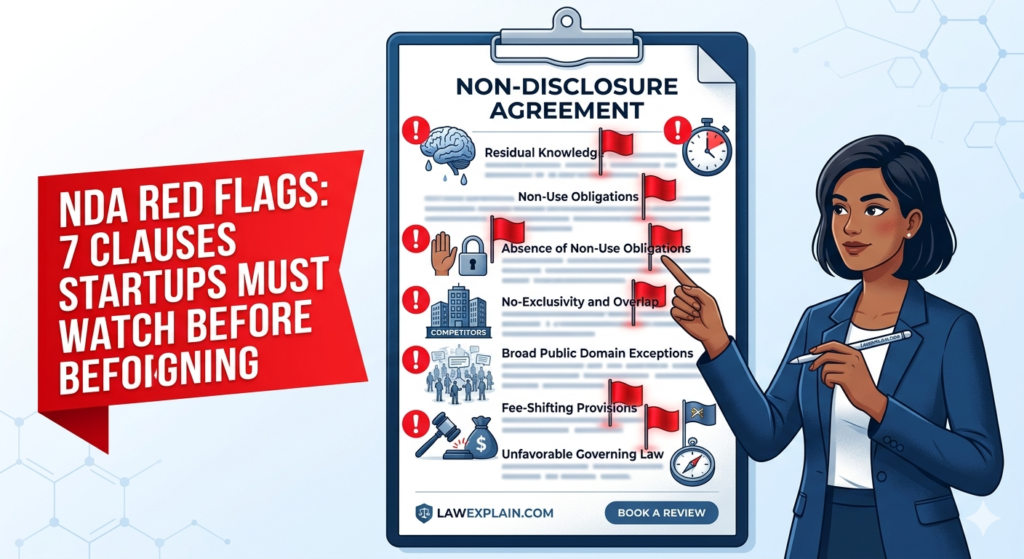
Here are the 7 most common red flags I see in my practice, and why they matter for your startup.
1. The “Residual Knowledge” Clause
This is arguably the most dangerous “hidden” provision. It typically states that the receiving party can use any information that remains in the “unaided memory” of their employees after the agreement ends.
- The Reality: It creates a massive loophole. While the other party might not leak your physical documents, they could technically use your core strategies or insights to help a competitor, claiming they simply “remembered” the idea.
- The Advice: If you are sharing truly innovative concepts, this clause should be narrowed significantly or removed. Secrets shouldn’t be fair game just because someone has a good memory.
2. Unreasonably Short Confidentiality Periods
I often see NDAs that expire after just six months or a year.
- The Reality: In the startup world, your roadmap, pricing strategy, and customer data often remain highly sensitive for years. If the NDA expires too early, your “moat” disappears before you’ve even finished building it.
- The Advice: Aim for a duration that matches the commercial “shelf-life” of your secrets. For most tech companies, 2 to 3 years is the professional standard.
3. The Absence of “Non-Use” Obligations
This is a classic “legal gap.” An NDA might forbid someone from disclosing your info (telling others) but say nothing about using it themselves.
- The Reality: Without a “Non-Use” restriction, a recipient could use your internal data to build their own competing product or pivot their strategy. Technically, they haven’t “leaked” anything, but they’ve still harmed your business.
- The Advice: Ensure your NDA explicitly states that the information can only be used for the specific project or evaluation at hand.
4. No-Exclusivity and Competitive Overlap
Investors frequently include a line saying the NDA doesn’t stop them from engaging with or investing in your competitors.
- The Reality: While this is a standard reality of the VC world (they can’t freeze their entire investment thesis for one meeting), it creates a risk. Your proprietary metrics could indirectly influence their decisions regarding a rival.
- The Advice: You may have to accept this clause, but you must double down on “Non-Use” language to ensure your data stays behind a strict metaphorical wall.
5. Overly Broad “Public Domain” Exceptions
Every NDA has “carve-outs” for info that is already public. However, predatory drafts include anything that “could have been” independently discovered or obtained.
- The Reality: This is too vague. If an exception is this broad, it becomes almost impossible to prove a breach because the other party can claim they could have found that info elsewhere, even if they actually got it from you.
- The Advice: Keep exclusions narrow and strictly defined to information that is actually and verifiably public.
6. Fee-Shifting Provisions
This clause says the “losing party” in a dispute pays everyone’s legal bills.
- The Reality: While it sounds fair, it’s often a “bully” tactic. A well-funded firm can drag out a legal battle until a startup is forced to settle or drop the case just to avoid the risk of a massive legal bill.
- The Advice: Think carefully about whether this creates a fair balance or if it effectively prices you out of ever enforcing your rights.
7. Unfavorable Governing Law and Jurisdiction
This determines where the fight happens. If you’re in London, but the NDA points to the courts of Delaware or Singapore, you’re at a disadvantage from day one.
- The Reality: The cost of hiring foreign counsel and traveling for hearings can make a lawsuit more expensive than the breach itself.
- The Advice: Always push for a jurisdiction that is accessible to you, or at least a neutral ground that doesn’t grant the other side a “home-court” advantage.
Why Legal Interpretation Matters
Courts don’t rewrite contracts to be “fair” they interpret exactly what is written on the page. Even a single loosely drafted word can turn a protective shield into a useless piece of paper. https://lawexplain.com/nda-clauses-understanding-startup-guide/
Identifying these red flags isn’t about being “difficult” in negotiations; it’s about ensuring the protection you think you have is actually there.
Wrapping Up the NDA Series
This concludes our deep-dive into Non-Disclosure Agreements. We’ve gone from the basics of what they are, to the clauses you must include, to the traps you must avoid.
The biggest takeaway? An NDA is never just a formality. Its strength depends entirely on the precision of its drafting and the care taken during review.
Need help with NDA drafting, review, or contract risk analysis?
Let’s connect on LinkedIn: https://www.linkedin.com/in/anshikaagarwal18/ and discuss how I can help protect your business legally.

I work in the corporate and technology law space, with hands-on experience in drafting and reviewing commercial agreements, supporting compliance functions, and advising on legal issues faced by startups and growing businesses. My work has involved contracts, data protection, regulatory research, and legal support for technology-driven organizations.
I created this platform with a simple belief: law should be understandable, not intimidating. Founders, professionals, and non-lawyers often interact with legal documents without truly understanding them. My aim is to break down legal concepts, clauses, and terminology into clear, practical explanations that help people make informed decisions.
This space focuses on explaining law in plain language, especially areas like contracts, legal English, compliance basics, and everyday legal risks faced by businesses. The goal is not to replace professional advice, but to make legal knowledge accessible and actionable.
Through this platform, I also collaborate with startups, founders, and professionals on contract review, legal documentation support, and compliance-related work.