
NDA Clauses Deep-Dive: Every Clause Explained with Interpretation Examples (Part 2)

In the previous article of this series https://lawexplain.com/non-disclosure-agreement-nda-for-startups/, we explored the basics of Non-Disclosure Agreements (NDAs)—what they are, the different types, and why startups and founders rely on them before sharing sensitive information.
Now comes the real value: understanding the clauses that make or break enforcement.
The real protection lies in how the clauses inside the agreement are written.
A poorly drafted clause can make an NDA almost useless in court. On the other hand, carefully worded clauses can turn the same document into a powerful legal safeguard.
This deep-dive (Part 2 of my NDA Mastery Series) breaks down every essential clause with table summaries, interpretation examples from my Legal Interpretation 101 post, and founder-friendly explanations.
Why NDA Clauses Matter
Many founders assume that downloading an NDA template from the internet is enough to protect their ideas. Unfortunately, this is one of the biggest legal mistakes startups make.
Courts do not fix vague contracts. Instead, they interpret agreements based on the exact language used by the parties. Remember these rules from my interpretation post?
This means that every word in an NDA carries legal significance.
For example:
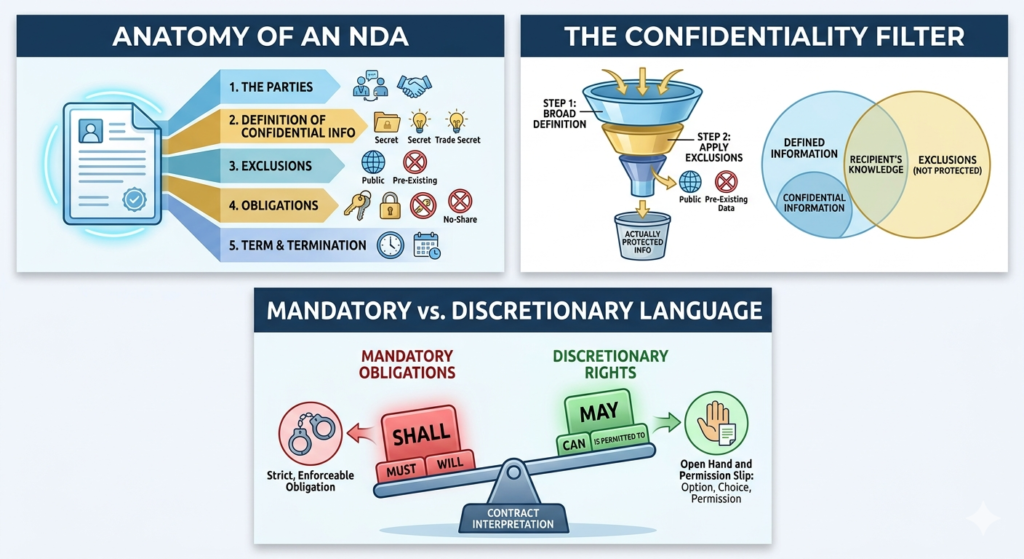
- “Shall” usually creates a mandatory obligation
- “May” gives a discretionary right
- Courts interpret contracts as a whole, not by isolated clauses
- Context reveals intent, but it cannot override clear wording
Understanding these principles helps founders draft NDAs that are actually enforceable.
The 10 Essential NDA Clauses (Table Breakdown)
| Clause | Purpose | Must-Have Wording | Interpretation Example | Common Founder Mistake |
| 1. Parties | Identifies who is bound by the agreement | “Discloser: XYZ Startup Inc. / Recipient: John Doe” | Courts must know exactly who signed the NDA. | Naming a company but having an individual sign without indicating representation, or naming an individual when the company receives the information. |
| 2. Confidential Information Definition | Specifies what information is protected | “Business plans, pitch decks, financial data, algorithms, software code, product designs, customer lists, marketing strategies, trade secrets, and information marked ‘Confidential’ or reasonably understood as confidential.” | Courts often reject definitions that are overly broad. | Using phrases like “all information discussed.” |
| 3. Exclusions | Lists information not protected by NDA | “1, not limited to only “already” is or becomes generally available to the public other than as a result of disclosure by Recipient in breach of this Agreement. 2. was available to Recipient on a non-confidential basis as shown in written records prior to its disclosure to Recipient by Disclosing Party3. becomes available to Recipient on a non-confidential basis from a source other than Disclosing Party; provided that such source is not bound by a confidentiality agreement with Disclosing Party or is otherwise prohibited from transferring the information to Recipient by a contractual, legal or fiduciary obligation.” | Courts read this clause together with the definition. | Forgetting to include legal disclosure exceptions. E.g. Missing “Court Order” exception = Breach claim even if legally required. |
| 4. Obligations | Core duties of the receiving party | “Recipient shall not disclose confidential information except: 1. Employee with need-to-know. 2. Legal requirement (with notice)” | “Shall” creates a clear legal obligation. | Using weak wording like “may not disclose.” |
| 5. Term / Duration | Determines how long confidentiality lasts | “3 years from disclosure” or perpetual for trade secrets | Courts prefer clearly defined time limits. | Writing “indefinite duration.” |
| 6. Permitted Disclosure | Allows limited exceptions | Disclosure to advisors or legal authorities | “May disclose” indicates a permitted right. | Not requiring prior notice to the disclosing party. |
| 7. Return or Destruction of Information | Ensures documents are returned after use | “Recipient shall return or destroy copies within 30 days.” | Mandatory wording strengthens enforcement. | Using optional language like “preferably return.” |
| 8. Remedies | Specifies legal consequences of breach | “Injunctions, damages, attorney fees. Prevailing Party recover costs.” | Courts enforce clearly stated remedies more easily. | Leaving remedies vague. |
| 9. Governing Law and Jurisdiction | Determines where disputes are resolved | “Governed by the laws of [state/country]. Disputes: [Arbitration/Court]in [City]” | Important for cross-border agreements. | Not specifying jurisdiction. |
| 10. Miscellaneous Clauses | Covers all aspects of the agreement | Entire agreement, severability, amendments in writing | Prevents reliance on verbal promises. | Treating boilerplate clauses as unimportant. |
Interpretation Examples: From My Last Posthttps://lawexplain.com/rule-of-interpretation-contract-law-real-cases/
Apply the Ashville (1988) principle: Courts read exact words, ignore “what we meant.”
Understanding legal drafting becomes easier when we look at how courts interpret specific wording.
Example 1: Obligations Clause
Weak clause: “The recipient shall keep confidential information confidential.”
Although the obligation is clear, the clause does not specify how long the duty lasts.
Improved clause: “The recipient shall keep confidential information confidential for a period of three years from the date of disclosure.”
Now the obligation is complete and easier to enforce.
Example 2: Remedies Clause
Weak clause: “The discloser may seek legal remedies for breach.”
The problem here is ambiguity. What remedies?
Improved clause: “The discloser may seek injunctions, damages, and recovery of attorney fees. The prevailing party shall recover litigation costs.”
Clear remedies provide stronger legal protection.
Example 3: Definition and Exclusion Together
Consider these two clauses:
Definition:
“Confidential information includes all business information disclosed during discussions.”
Exclusion:
“Information that becomes publicly available will not be considered confidential.”
Courts read these clauses together, not separately. The exclusion ensures the NDA does not unfairly restrict information already available to the public.
The Founders Mistake: Ignoring Boilerplate
Many founders skim through the miscellaneous section of an NDA but they’re your legal backbone.
Key examples include:
- Entire Agreement Clause : Prevents parties from claiming that verbal promises changed the agreement.
- Severability Clause: If one clause becomes invalid, the rest of the contract remains enforceable.
- No Waiver Clause: Ignoring a minor breach today does not mean future breaches are allowed.
- Notice Clause: Specifies how official communication must be delivered (email, registered post, etc.).
Without these clauses, disputes become significantly harder to resolve.
Practical Steps for Founders
If you are using NDAs in your startup, keep these practical points in mind:
- Use clear and precise wording in every clause.
- Avoid overly broad definitions of confidential information.
- Specify the duration of confidentiality obligations.
- Ensure governing law and jurisdiction are clearly stated.
- Always sign the NDA before sharing sensitive information.
Following these simple practices can dramatically improve the legal strength of your NDA.
What’s Coming Next (Part 3)
The next article in the NDA Mastery Series will focus on:
“The 7 Biggest NDA Mistakes That Can Destroy Startup Protection.”
We will cover:
- Red flags in investor NDAs
- Common drafting mistakes founders make
- How to identify weak NDA templates
Final Thoughts
A Non-Disclosure Agreement is only as strong as the clauses it contains. Templates alone do not guarantee protection. What truly matters is how clearly the obligations, definitions, and remedies are written.
When drafted carefully, NDAs become a powerful tool for protecting confidential information and intellectual property. When drafted poorly, they become little more than symbolic paperwork. https://www.linkedin.com/in/anshikaagarwal18/
Understanding these clauses helps founders move from paper protection to real legal security.
Protect your StartupToday
Weak NDAs = Stoler IP. Precise clauses = Peace of mind. This Framework works globally – tweak governing law for your jurisdiction.
Need Help? Freelance NDA drafting/reviews. Global founders welcome.
Quick Question: Which clause scares you most—definitions, remedies, or governing law? Drop below!
Part 3 drops next week: NDA Mistakes That Kill Startups
#NDA #ContractLaw #StartupLaw #LegalTips #Founders #SaaS

I work in the corporate and technology law space, with hands-on experience in drafting and reviewing commercial agreements, supporting compliance functions, and advising on legal issues faced by startups and growing businesses. My work has involved contracts, data protection, regulatory research, and legal support for technology-driven organizations.
I created this platform with a simple belief: law should be understandable, not intimidating. Founders, professionals, and non-lawyers often interact with legal documents without truly understanding them. My aim is to break down legal concepts, clauses, and terminology into clear, practical explanations that help people make informed decisions.
This space focuses on explaining law in plain language, especially areas like contracts, legal English, compliance basics, and everyday legal risks faced by businesses. The goal is not to replace professional advice, but to make legal knowledge accessible and actionable.
Through this platform, I also collaborate with startups, founders, and professionals on contract review, legal documentation support, and compliance-related work.
Test message. Thank you!